


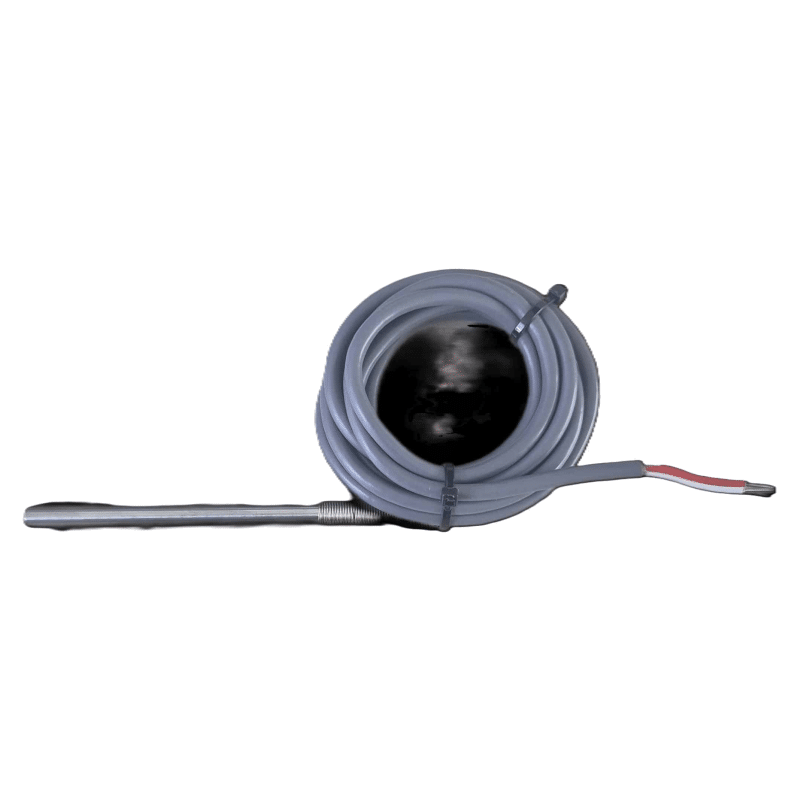
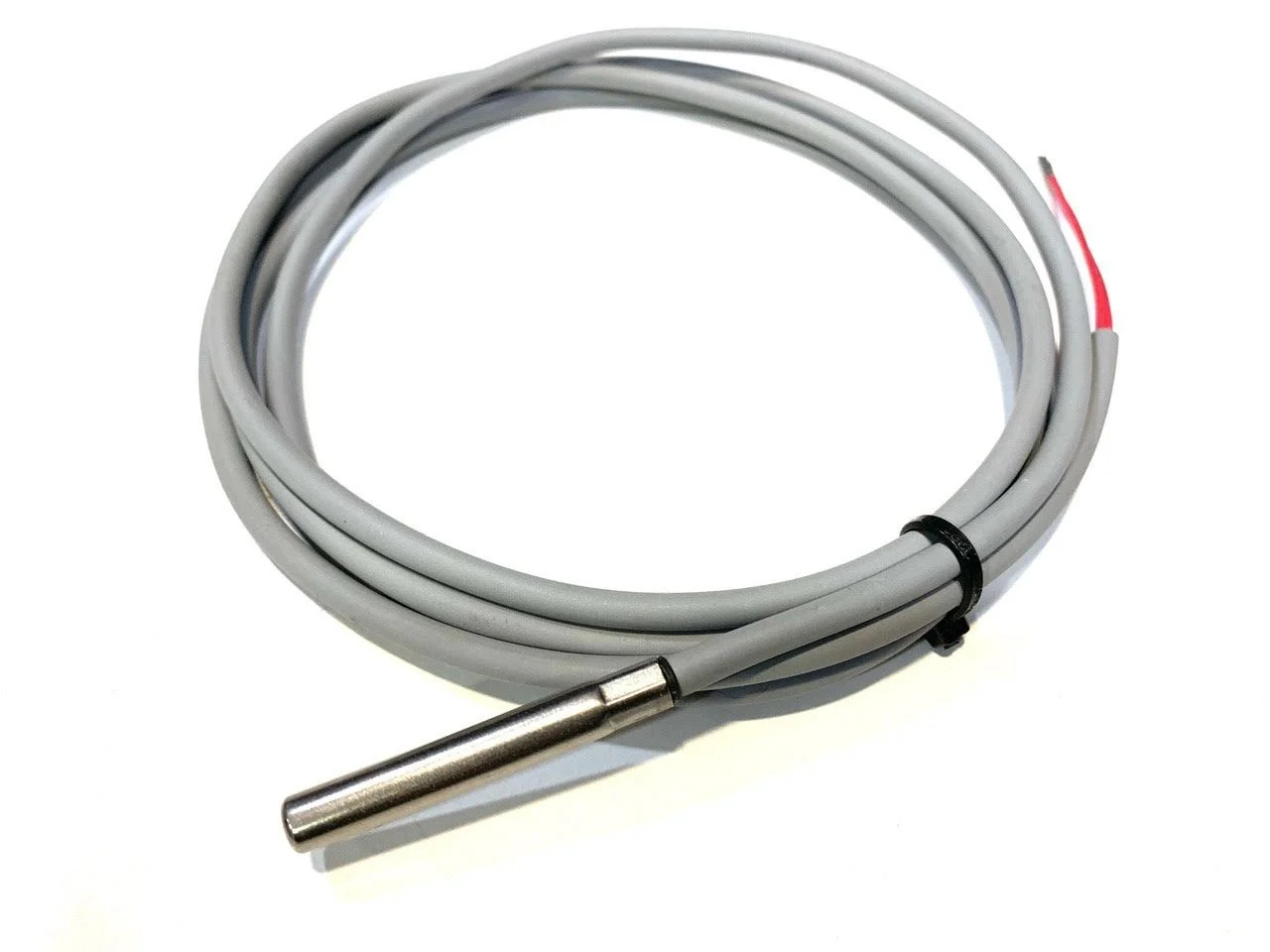
PT1000 temperature sensor
SKU: 190860€16.00 – €25.00Price range: €16.00 through €25.00 (21% BTW)
 PT1000 temperature sensor
Measuring range -50 to +200°C
Stainless steel element 10 cm
Cable 2m, 3m or 10m
Suitable for Myenergi Eddi
PT1000 temperature sensor for accurate measurements
Reliable temperature measurement from -50 to +200°C
The PT1000 temperature sensor is a versatile and reliable sensor that is extremely well suited for use in combination with the Myenergi Eddi and the SolarEdge water heater controller. With a wide measuring range of -50 to +200 degrees Celsius, this PT1000 temperature sensor is ideal for monitoring boilers, buffer tanks and other thermal applications within your solar energy system.
Robust design and flexible connection
Stainless steel sensor element with flexible PVC cable
The sensor is fitted with a sturdy stainless steel sensor element 10 cm long (on the 2 and 3 metre version) that is easy to place in an immersion sleeve or directly in a tank. The grey PVC cable is available in various lengths (2 m, 3 m and 10 m) and can be connected either 2-wire or 3-wire using wire end ferrules. When using the Eddi or SolarEdge water heater controller, the GND wire is not used.
Perfectly compatible with Myenergi Eddi and SolarEdge
Plug-and-play for hot water controls
This PT1000 temperature sensor was specifically chosen for its seamless compatibility with popular hot water controllers in solar energy installations. Whether you want to use surplus solar power via a Myenergi Eddi or a SolarEdge water heater controller: this sensor gives your system exactly the information it needs to produce hot water efficiently.
Technical specifications
- Type: PT1000 (1000 Ohm at 0°C)
- Measuring range: -50 to +200 °C
- Sensor element: stainless steel, 10 cm long (on the 2 m and 3 m version)
- Cable lengths: 2 m, 3 m or 10 m
- Connection: 2-wire or 3-wire with wire end ferrules
- Cable sheath: grey PVC
- Compatible with: Myenergi Eddi, SolarEdge water heater controller
Pro tip: A 3-wire PT1000 is intended for a 3-wire measurement, in which the third wire is used to compensate for the resistance of the connecting cable. If your controller only has 2 connections for a PT1000, you use it as a 2-wire sensor.
On a typical 3-wire PT1000 there are two wires on the same side of the measuring element. You then connect:
- one of the two identical wires to connection 1;
- the differing/other wire to connection 2;
- you leave the remaining third wire free and insulate it.
For example, with 2× red + 1× white:
Red → PT1000 connection 1
White → PT1000 connection 2
Other red → do not connect
You can easily check this with a multimeter. Between the two wires that belong together you measure virtually 0 Ω. Between one of those two wires and the third wire you measure approximately 1000 Ω at 0 °C, around 1095–1100 Ω at room temperature.
The only drawback of a 2-wire connection is that the cable resistance is not compensated. With a PT1000 and a normal cable length, that deviation is usually very small.
| Weight | N/A |
|---|---|
| Length | 2m, 3m, 10m |
