


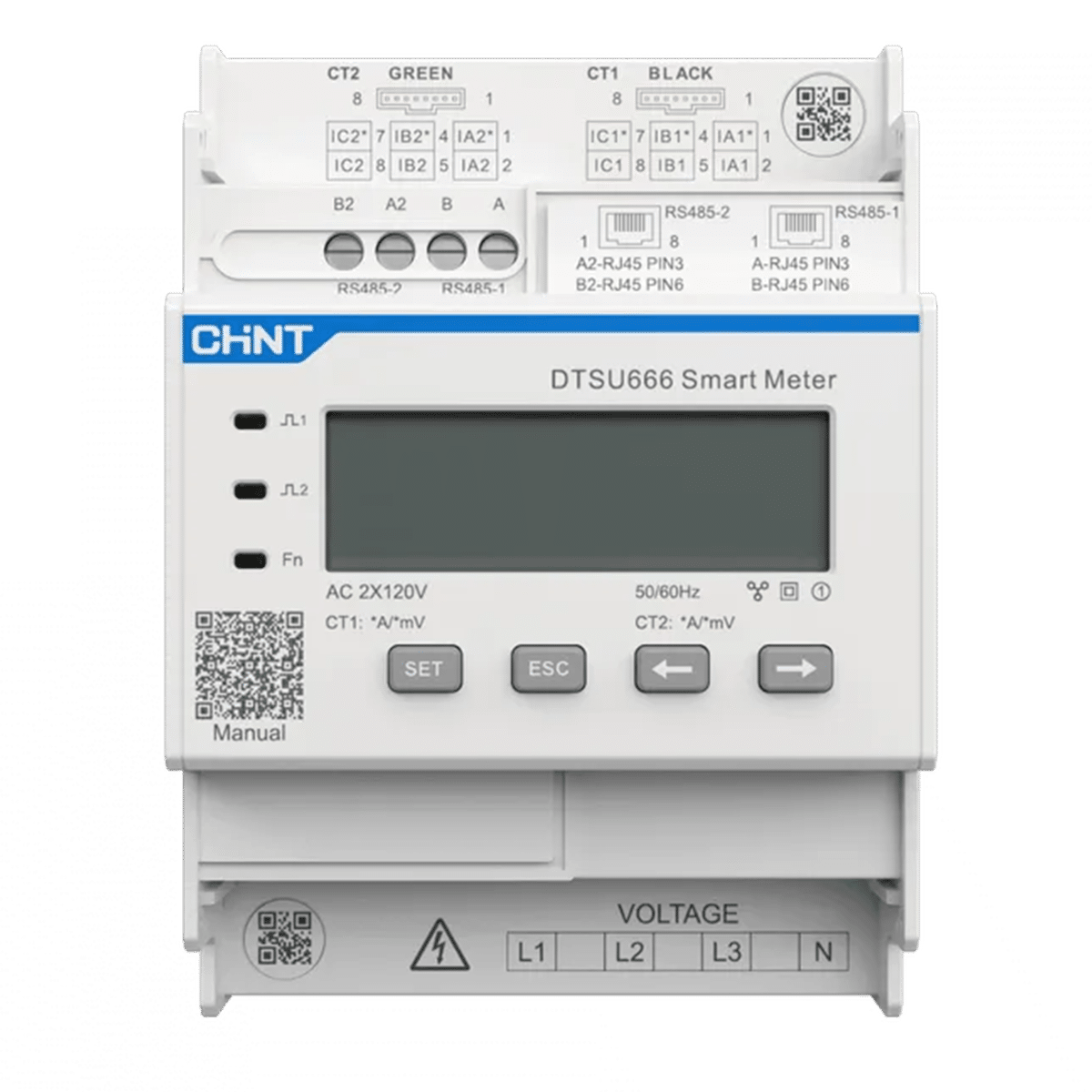
Growatt Smart Meter TPM-6CT-C-EU
SKU: 251696€225.00 – €270.00Price range: €225.00 through €270.00 (21% BTW)
MPN: MR00.0037600
Growatt Smart Meter TPM-6CT-C-EU – Smart 3-phase Meter for Efficient Energy Management
The Growatt Smart Meter TPM-6CT-C-EU is an advanced, three-phase smart meter that integrates seamlessly with Growatt’s APX battery systems and inverters. This meter makes it possible to scale up existing PV installations of more than 8 kW with Growatt APX batteries, even in three-phase systems.
Key Features
- Efficient Grid Management and Export Limitation
The TPM-6CT-C-EU measures both the import and export of energy to and from the grid. This enables export limitation, ensuring that surplus energy can be utilised optimally without overloading the grid. - Versatile Compatibility with Growatt Storage Systems and EV Chargers
This smart meter works seamlessly with Growatt’s energy storage systems andEV chargers, ensuring integrated and efficient energy management for both domestic and commercial applications. - Accurate Measurement and Reliable Connectivity
The TPM-6CT-C-EU provides accurate measurements with 0.5% voltage and current accuracy and 1% power accuracy. Thanks to Modbus RTU communication, there is a stable and fast connection to the inverter for real-time data exchange.
Installation and Technical Specifications
- Mounting: Easy to install on a DIN rail.
- Input voltage: Suitable for voltages of 100–415 V (3P3W) L-L and 57.7–240 V (3P4W) L-N.
- Operating temperature: Designed to operate between -25°C and +55°C.
- Communication: Equipped with RS485 communication and Modbus RTU protocol, with a baud rate of 9600 baud.
The Growatt Smart Meter TPM-6CT-C-EU is the ideal choice for anyone wishing to expand their 3-phase PV system with a Growatt battery and make the most of export limitation and efficient integration with other Growatt devices.
Connecting CT clamps to the correct phase
In a three-phase system, it is important that each CT terminal is connected to the correct phase.
This means that CT1 is connected to L1, CT2 to L2 and CT3 to L3.
This is because the energy meter, inverter or battery controller combines the current measurement from the CT terminal with the voltage measurement from that same phase.
If a CT clamp is connected to the wrong phase, the system may detect current, but the power will be calculated incorrectly.
As a result, consumption, feed-in, import, export and battery control may be displayed or managed incorrectly.
How do you check whether the CT clamp is on the correct phase?
You can check this using a multimeter set to the AC voltage setting.
The principle is simple: you compare the wire around which the CT clamp is fitted with the voltage input of the phase to which that CT belongs.
For example, measure between:
- the conductor wrapped by CT1 and the L1 voltage terminal
- the conductor with CT2 clamped around it and the L2 voltage terminal
- the conductor with CT3 clamped around it and the L3 voltage terminal
If you measure between the same phase points, the voltage difference will be approximately 0 V to a few volts.
If you measure between two different phases, you will usually measure approximately 400 V.
Practical rule of thumb
- 0 V or nearly 0 V = same phase
- approximately 400 V = different phase
Example: if you measure approximately 400 V between the conductor of CT1 and L1, but approximately 0 V between that same conductor and L2?
Then CT1 is not connected to L1, but to L2.
What voltages can you normally expect?
In a standard three-phase installation in the Netherlands, you will usually see approximately:
- L1 – N ≈ 230 V
- L2 – N ≈ 230 V
- L3 – N ≈ 230 V
- L1 – L2 ≈ 400 V
- L2 – L3 ≈ 400 V
- L1 – L3 ≈ 400 V
These measurements will help you to check whether the voltage connections are correctly wired and whether the CT terminals are connected to the correct phase.
Also carry out a load test
An additional practical check is a load test. Switch on a clearly identifiable single-phase appliance, such as a kettle, a site lamp or an electric heater,
and check the meter, the app or the monitoring system to see on which phase the consumption increases.
- Load on L1 switched on → only L1 should show a clear increase
- Load on L2 switched on → only L2 should show a clear increase
- Load on L3 switched on → only L3 should show a clear increase
If the load appears on the wrong phase, the CT terminals have been swapped or the connection between the current and voltage measurements is incorrect.
Also pay attention to the direction of the CT clamp
As well as the correct phase, the direction is also important. Many CT clamps have an arrow on them.
This arrow indicates how the direction of current is interpreted. If the CT clamp is fitted the wrong way round, the system may reverse import and export.
Do you see negative values or illogical feed-in during normal consumption? If so, there is a good chance that the CT clamp is fitted the wrong way round.
What else should you look out for?
- Always fit the CT clamp around a single live wire, usually the phase.
- Do not fit it around a complete cable containing both the phase and neutral, otherwise the magnetic fields will cancel each other out.
- For three-phase systems: follow the sequence CT1-L1, CT2-L2, CT3-L3.
- Click the CT clamp fully shut.
- If you encounter unusual readings, always check the phase connection first and then the direction.
These measurements are often carried out in the meter cupboard on live phase conductors. Use only suitable measuring equipment and work safely.
If you are unsure about the measurement or the connection, have this carried out by a qualified installer.
Please note: CT clamps are not simply interchangeable
A CT clamp may look like a simple measuring clamp, but technically speaking it is a key component of the measurement.
The inverter, energy meter or home battery expects a very specific signal from the CT clamp. That is why a CT clamp is not simply
interchangeable with one of a different make or type.
A CT clamp measures the current flowing through a cable and converts it into a small measurement signal. That signal could, for example, be a small current,
such as 50 mA, or a small voltage, such as 333 mV or 1 V. The connected device then calculates
that measurement signal back to the actual current in amperes.
If the ratio or the output signal is incorrect, the system will measure incorrectly. Whilst this is merely a nuisance in standard energy metering, in the case of a home battery, dynamic control or export limitation, it can cause the system to regulate in exactly the wrong direction.
Which characteristics need to match?
- CT ratio, for example 100A/50mA, 120A/40mA or 100A/333mV.
- Output type: current output in mA or voltage output in mV/V.
- Maximum measurement current, for example 100A, 120A or 250A.
- Burden resistor: is the measuring resistor located in the CT terminal or in the device?
- Pinout and plug: a plug that fits is not automatically electrically compatible.
- Current direction and polarity: important for import, export, charging and discharging.
- Accuracy and phase shift: particularly important for power measurement.
You should therefore only use this CT clamp with devices for which it is suitable according to the manufacturer. If in doubt, it is better to use the original
CT clamp or check the specifications carefully before connecting.
How does a CT clamp work?
CT stands for Current Transformer. The CT clamp contains a magnetic core surrounded by a coil.
The cable around which you clip the clamp forms the primary side of the transformer. This is usually a single winding: the phase cable itself.
When alternating current flows through the cable, an alternating magnetic field is generated around it. The core of the CT clamp captures this
magnetic field. This generates a small electrical signal in the coil of the CT clamp. The more current that flows through the cable,
the greater the measurement signal becomes.
Why can an incorrect CT clamp cause problems?
An incorrect CT clamp can cause the device to measure a value that is too high, too low or even reversed. With solar panels and
home batteries, this can have serious consequences.
- The battery charges when it should actually be discharging.
- The battery discharges when there is actually surplus solar power available.
- The inverter thinks power is being fed back into the grid whilst power is actually being drawn from it.
- The export limit does not work properly or responds too late.
- The displayed consumption or feed-in figures are incorrect.
- A three-phase system is measuring the phases incorrectly or mixing them up.
How can you tell what type of CT clamp you have?
Always start by checking the label or the datasheet. Many CT clamps state the ratio directly, for example:
- 100A/50mA – current output
- 120A/40mA – current output
- 100A/333mV – voltage output
- 250A/5A – industrial current transformer
- 2000:1 – ratio between primary and secondary current
Does the CT terminal say ‘mA’? If so, it is usually a CT with a current output. Does it say ‘mV’ or ‘V’?
If so, it is usually a CT with a voltage output, often with a built-in measuring resistor.
You can use a multimeter to measure the resistance between the two wires of the CT terminal. This does not directly indicate the exact CT ratio,
but it can help to determine whether the terminal is open-circuited and whether a coil or built-in measuring resistor is likely to be present.
If you want to check the ratio, you can test the CT terminal with a known load. For a CT terminal with a voltage output, measure using
the multimeter in AC mV or AC V. If, for example, you measure approximately 33 mV at 10 A, this converts to
approximately 333 mV at 100 A. This indicates a 100 A/333 mV CT clamp.
With a CT clamp with a current output, you usually need to use a suitable burden resistor to ensure a safe and accurate measurement. This converts
the secondary current into a measurable voltage. Only do this if you know what you are doing, and ensure that a conventional current CT does not remain open
whilst current is flowing through the primary cable.
What should you bear in mind when connecting it?
- Place the CT clamp around a single loose conductor, usually the phase. Do not clamp it around a complete cable containing both phase and neutral.
- Pay attention to the direction of the arrow on the CT clamp. The direction determines how import and export are interpreted.
- For three-phase systems: connect CT1 to L1, CT2 to L2 and CT3 to L3.
- Check the phase sequence if values are displayed as unusual or negative.
- Click the CT clamp fully shut. A poorly closed connection may result in inaccurate measurements.
- Do not simply extend CT cables. Excess length, poor connections or incorrect cables can affect the measurement.
- Position the CT at the correct measurement point, usually at the start of the installation, so that the system can measure all consumption and feed-in.
Only work in the meter cupboard if you know what you are doing. CT clamps are often fitted around main or phase conductors where dangerous voltages
and currents are present. Switch off the power safely where possible and, if in doubt, have the work carried out by a qualified installer.
| Weight | 2.19 kg |
|---|---|
| Merk | Growatt |
| Stroom | 100A, 250A |
